


 RT Booklovers Convention start on April 6th and if you’re going to be in Los Angeles, you won’t want to miss it. We paranormal fans are getting some series RT love with several dedicated panels including PARANORMAL: The Plot Thickens: How to Keep Paranormal Fans Hooked which features Shannon K. Butcher talking about the importance of worldbuilding, plotting, and pacing. Click HERE to see where else Shannon will be at this years convention.

 ATUF: How far in advance do you plot? Chapter by chapter? Book by book? Or do you plan out the who series before starting?
SB: I plot the high-level stuff for the whole series. I never start a series without knowing how it ends, and several important milestones along the way. When I get to each book, I plan it out thoroughly, including both the main plot, as well as any subplots I’ve included to develop the overarching storyline. Things in between those milestones can change as I go along, but in general, I stick to my roadmap, since that’s what’s going to get me to the end of the series with no plot threads left hanging.
ATUF: Do you find plotting in Paranormal Romance to be different from other genres?
SB: There’s more world building to do in paranormals, so that means that there are fewer words left for everything else. For me, that translates into text that is heavy on multitasking. I have to move the romance forward as well as deepening the world and keeping on track with the plot of this book as well as the plot of the series. Any scene that doesn’t do at least a couple of these things has to go, or my books would end up being doorstops.
I’ve taken a lot of what I learned in plotting suspenses and used that to help make my paranormals faster paced. My books usually span only a few days, which I think helps add to the sense of urgency of the characters. And the skills I developed in creating villains has also been useful in my paranormals.
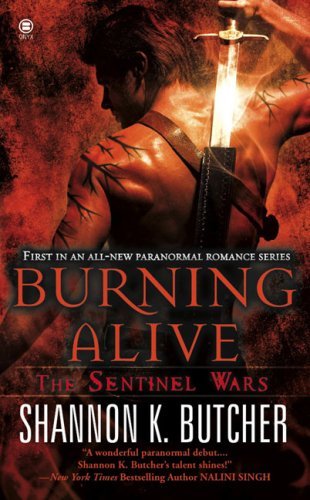
ATUF: There are currently four books in your Sentinel Wars series (with book 5, BLOOD HUNT, coming out in August). How do you maintain a story arc through the course of a series while still delivering a conflict and resolution in each book?
SB: I focus on one couple at a time. Within each book, you can be guaranteed that the main couple will find their happily ever after. While that’s going on, I also have a large cast of other characters that I’m developing into heroes or villains as we go along. This is where a lot of the overarching story happens. So, while there’s one complete story in each book, there are also other, longer stories going on that span several books.

ATUF: When and how does foreshadowing important events come into play?
SB: I like to play with foreshadowing, but I don’t spend a lot of time forcing it into the books. It has to be natural, or I don’t bother. For instance, in book one of the series, I mention things that will not come to fruition until the last book of the series, but it just kind of fell in place easily. I really try to create stories that are fun to read, but when you reread them (after having read subsequent books in the series and knowing characters’ secrets), you get a completely new take on the story.
ATUF: How important is it to ‘play by the rules’ you've established for your series when the world is paranormal?
SB: It’s vital to stick to your own rules. If you don’t, the reader is going to feel cheated. That being said, sometimes the characters THINK they understand the way things are, but they’re wrong. That’s fun to play with, too, but it has to be set up from the very beginning, or it doesn’t work.
ATUF: Does plotting become easier or more challenging the further along into a series you get?
SB: Plotting doesn’t become harder, but it is more intricate and complex. The more characters I have, the more storylines I’ve started, the more work it is to keep all those things alive and in the reader’s mind. I work hard to hit on several subplots in each book, to progress them, and to make sure the reader knows I haven’t forgotten. And I promise that I haven’t. I keep charts of plot threads (and what I plan to happen in which books) and copious notes so that I won’t forget.

SB: I try to use anthologies to tell those stories of behind-the-scenes action that would otherwise not have ended up in a story. For instance, in ON THE HUNT, the characters go in search of a magical healing artifact. That artifact is crucial to the overall story of the Sentinel Wars, but how it’s found is just a fun, exciting excursion. The reader doesn’t need to know how it’s found, just that it is. So, when I use that kind of story in an anthology, a new reader seeing only the novella will not be spoiled or confused, and someone who isn’t a fan of shorter fiction doesn’t need to read that work to understand what’s going on within the longer books. It’s a bit of a balancing act, but I think writing those shorter stories does enrich the world, and lets me play with characters I wouldn’t have otherwise had time to focus on.
ATUF: What’s the best way to bring new readers up to date on a series without subjecting long time fans to lengthy recap passages?
SB: There’s no getting around some repetition, but I do try to keep that to a minimum. I tend to write for the long time audience, but I do go back and add in text to clarify things that might be confusing to new readers. Using old characters to tell new characters what’s going on is one method. Simply stating the facts briefly within a character’s point of view is another easy way. This is one of those times where telling rather than showing a reader is a great tool. It’s not as much fun as reading it as it’s introduced originally, but it serves a necessary purpose.
ATUF: How do you find the balance between plot, prose, and character?
SB: I start with the characters. I love character-driven stories, so that’s what I tend to write. So, first I create the characters with goals, agendas, flaws, strengths, history, etc., and the stories come from there. I find this works only if the villains get the same thorough treatment as the heroes. With this method, the plot flows easily. I honestly don’t worry about the prose. That takes care of itself as I focus on the other things.

SB: I’m on the Faery Court this year, so I’m really looking forward to the masquerade on Thursday night. I’ve spent a lot of time getting my costume together (which requires several batteries) and I’m excited to see all the other fabulous costumes, and spend the evening dancing and having a good time.
ATUF: Which panel other than your own are you most excited about?
SB: I don’t know if you’d count it as a panel, but I’m really looking forward to the big book signing on Saturday. I’m always amazed at the energy in that room, and being surrounded by thousands of people who love books as much as I do. It’s truly one of those things that you have to see to believe.
ATUF: Thanks so much for stopping by Shannon. Come back anytime!
-------------------------------------------------
 When Shannon was little, she wanted to be a daddy. When she learned the anatomical improbability of that happening, she decided instead to become what her dad was: an Industrial Engineer.After she graduated, she went to work for a big telecom company earning a steady paycheck while her husband pursued his dream to become a published author. Her husband is Jim Butcher, fantasy and sci-fi author extraordinaire. She learned to write in an effort to help him improve his own work and as soon as she discovered that writing was more a learned skill than a natural talent she knew she had to give it a try. She lives in Missouri with her husband and their teenage son and a dog. |
| Visit Shannon online: |
Interested in being interviewed on All Things Urban Fantasy? CONTACT ME






No comments:
Post a Comment